

In this post, we’re going to reveal how to write a business website homepage that can help you win more clients.
Is this the only way to do it? No. But the elements we’ll look at are generally acknowledged by leading players in the industry as the things you’ll want to include if you’re looking for more leads and sales.
There’s one overarching principle that will feel like a 180-degree skew to anyone new to the world of marketing: knowing how to write homepage content is not about talking about you all that much – it focuses on your customer.
What problem do they want you to solve? What’s causing them anxiety when they think of parting with their cash?
See everything you write from the point of view of your visitors’ needs and you will see an improvement in your results.
Here’s a breakdown of how to write a business website homepage, using our own copywriting services website as an example.
You might also like to read our post ‘How to Write Content for Websites That Actually Wins Leads and Sales’ to learn some general principles for writing website content.

Above the fold (ATF) is the uppermost portion of your website people read before they start scrolling, as pictured above. Data from services such as Microsoft Clarity and HotJar, which ‘heatmap’ user activity, reveal it is often the only part many people will read before clicking off (hopefully to another of your pages).
You’ll win or lose most business here. This is how to write homepage content for the ATF section.
The headline:

Start with a short, grabby headline that describes a strong benefit for your target customer. Even if you use ChatGPT for inspiration, it’s going to be the hardest piece of copy you ever write, because you’ll be trying to crystalise your major benefit in a few short words. Try 10, 20 or 50 versions until it feels right.
Just, for God’s sake, don’t write ‘Welcome!’ and leave it at that. (Unless you sell Welcome mats.)
The subhead:
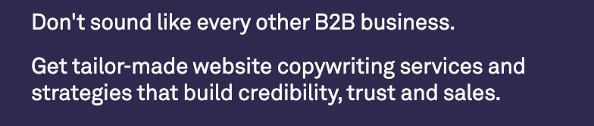
Then elaborate on this headline in the subhead, describing what you do but continuing to focus on the benefits to customers. You can also use this section to suggest an implicit ‘pain point’, to identify with your customer and show a point of difference. In our case, we’re playing on their fear of ineffective, bland and boring – ‘being like everyone else’.
The call to action:

As we mentioned, many people won’t scroll past the ATF section, so you must give them a chance to contact you here. Don’t just write ‘Get in touch’ or something bland. Use your call-to-action button text as an opportunity to introduce some personality and urgency.
Trust signals:

So you’ve talked a big game, but maybe that just makes you a skilled BS merchant?
You now need to reassure visitors that you’re the real deal and not some chancer with zero experience.
Client logos are the answer. By showing visitors who you work with – prominently – you’re swiftly allaying their fears. Introducing this one element at the top of the website can be a game-changer.
Knowing how to write a business website homepage is all about getting this ATF section right. Hone and refine until you can do no more.
Remember the last time you started to get interested in a service online. As soon as the merest twinkle of interest glimmered, didn’t you immediately search for more reassurance?
It’s natural. Interest implies possibly signing up, and paying out. It’s scary. So, ironically, when a client becomes interested in you, they also become more defensive and likely to run away.
‘How do I know I can trust you?’ they say.
Answer: because you’re going to follow the ATF with further trust signals. Here they are…
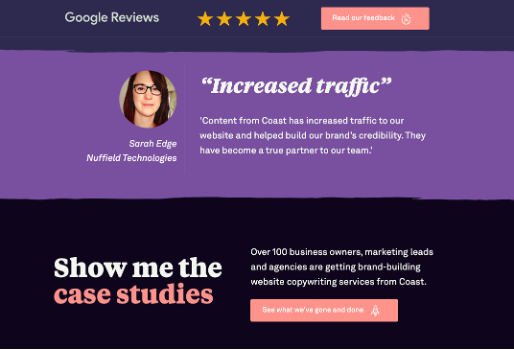
In our case, we’ve shown a link through to Google Reviews.
Then we’ve shown a testimonial (and there are lots more of these sprinkled on the homepage).
And, finally, we’ve provided a link through to our digital content marketing case studies.
Use trust signals prominently on your homesite and you’re doing the work of a thousand words.
Knowing how to write a business website homepage is partly about showing your relentless commitment to your customer’s point of view.
(And notice that this far in we’re still focusing on the customer’s needs, not talking about you very much yet.)
In this section, we are pushing the pain points.
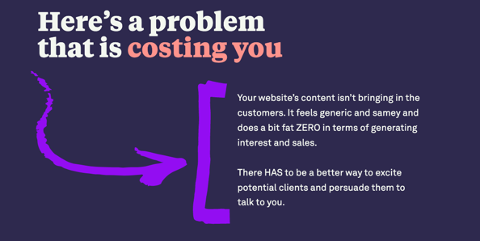
We know that customers in B2B often struggle to get leads and conversions from their website. We also know that most settle for a generic and unremarkable approach to content.
We’re throwing a little more itching powder on this pesky itch, to amplify the pain.
Why? Because if you can mirror what your potential customer is feeling, you will build empathy. And command their attention.
Now is the time to set out your stall and reveal some of the reasons why your solution works.
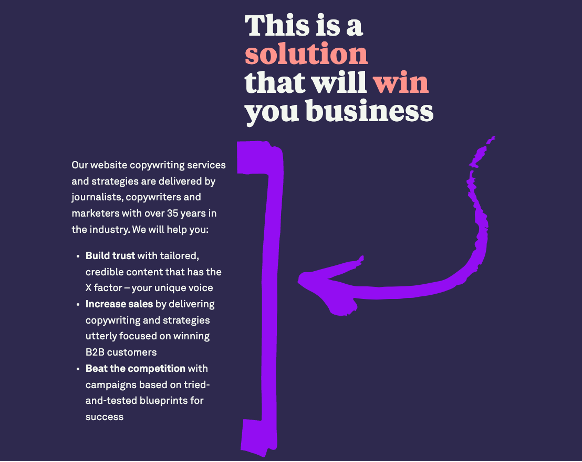
We’ve focused on our deep experience, the tailored nature of our offer (as opposed to generic content), and our experience working in the B2B sector.
Notice how all of this is put across through the prism of the customers’ needs: ‘Build trust’, ‘Increase sales’ and ‘Beat the competition’. We’re still thinking from their point of view – even when we’re saying what we do.
We don’t do just one thing, so it’s important we channel customers to the right services pages. If the same applies to you, include a clear section – a tiled format like the below works visually – that describes your various offers, so potential clients can click and learn more.
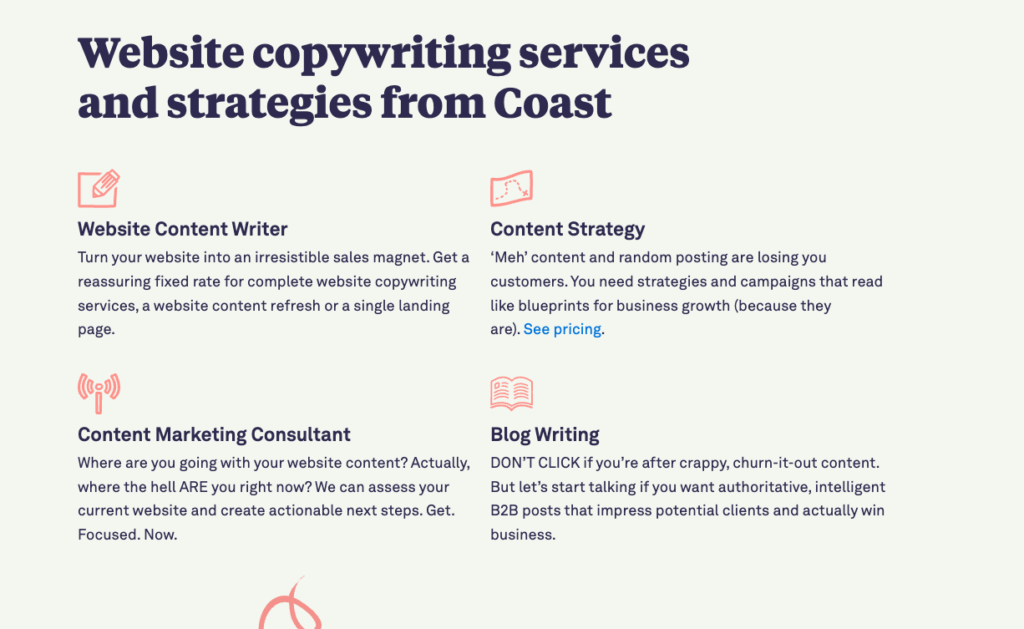
Notice that the descriptors we’ve used aren’t merely informational, describing ‘what we do’. They use emotional triggers that work hard to connect with the audience. Find out more about using emotion in your website copywriting.
While we have a dedicated content marketing case studies page elsewhere on the website, we’ve put some of our results front and centre on the homepage with a series of ‘mini case studies’.
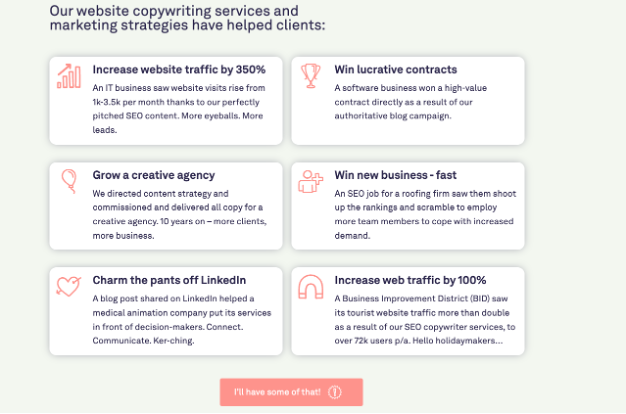
Notice in these examples how the headline shows a clear benefit – we could have written ‘Case study for IT firm’. Instead, we put the most impactful, scannable benefit right there at the top: ‘Increase website traffic by 350%’.
This is a good point to mention an important principle for all the copy on your homepage and website. Most people will be scrolling and reading the bits that interest them. So, keep each section/ paragraph bite-sized and include strong heads and subheads throughout – ones that are informative AND feature a benefit/emotional hook wherever possible.
Finally, we introduce ourselves and put our personal credentials to the fore.
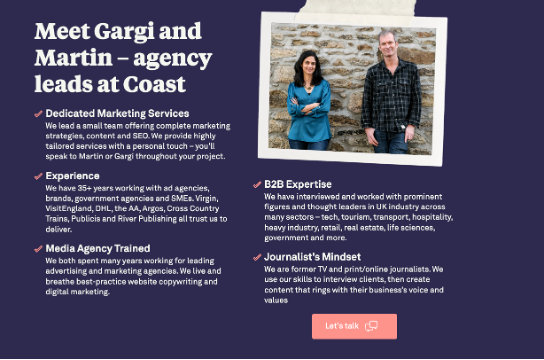
There will be an overwhelming urge to put this kind of personal information (or company information if you are a larger organisation) right at the top of your homepage.
Doing that isn’t wrong. But most digital marketers agree that it is far better to concentrate your main efforts on solving your customers’ needs and, only when these are satiated, answer their follow-up question: ‘SO who the hell are these people, anyway.’
Naturally, the body of this section will focus on your experience.
Don’t forget to include a final call to action.

You don’t want someone to scroll all the way to the bottom of your website and have nowhere to go!
Most website copy is terrible fluff. This is because you can’t build a case out of thin air – and so many people try to do just that.
In fact, if you asked us how to write a business website homepage in one sentence, our answer would be: have something to write about!
If that sounds trite, take a look around the internet at the B2B businesses that have nothing to say but waffle. ‘Passion’, Commitment’, ‘Integrity’ – it’s bullshit bingo and it’s words about nothing.
The antidote to all of this is research. If you follow the points below, you will definitely have plenty to write about and won’t come across like a windbag.
1) Pain points. Discover your audience’s pain point. What problem are they coming to you to solve? Talk to existing clients and use Q&A platforms such as Reddit and Quora to discover the burning issues that give them stomach ulcers.
2) Benefits. List all of the benefits of working with you. Don’t focus on the process; concentrate on the fabulous end result. Not, ‘get great website copy’, but ‘enjoy a higher conversion rate and win more customers’.
3) Bad alternatives. Describe what your poorer competitors do (without naming them). By showing what bad looks like, you can get visitors a clearer sense of why what you offer will appeal.
4) USPs. List your unique selling propositions. These are slightly different from the benefits section above. They are the unique, or standout, things about your business that set you apart from the competition. They will typically be more about your working processes than results, and will most likely live in the section where you talk about your business. Examples include a product that does things very differently from competitors, a major industry award, or Dominoes 'get your pizza in 30 minutes or get it free'.
5) Clients. List all the clients you’ve worked with.
6) Testimonials. Gather all your client testimonials – or get more if you don’t have enough.
If you follow points 1-6, you’ll have all the information you need to know how to write homepage content and you can start constructing your page as outlined in our step-by-step guide above.
Coast Copywriting helps B2B websites get more leads and customers through digital strategies and copywriting. Find out about our website content writer services. You can also see content marketing case studies revealing how we’ve helped clients like you. Or get in touch now.
Further reading
See the following related posts:
B2B Businesses: This is How to Write Content for Websites That Actually Wins Leads and Sales provides an overview on writing website content, looking at general principles.
Features and Benefits in Copywriting: What They Are and Why Benefits Matter Most (Apart From When They Don't) digs deep into a fundamental concept in copywriting. Definitely read before you start writing.
Tone of Voice in Copywriting: Here's How I Changed My Approach to Build More Sales For My Clients will give you an insight into how to develop a persuasive voice for your B2B business.